
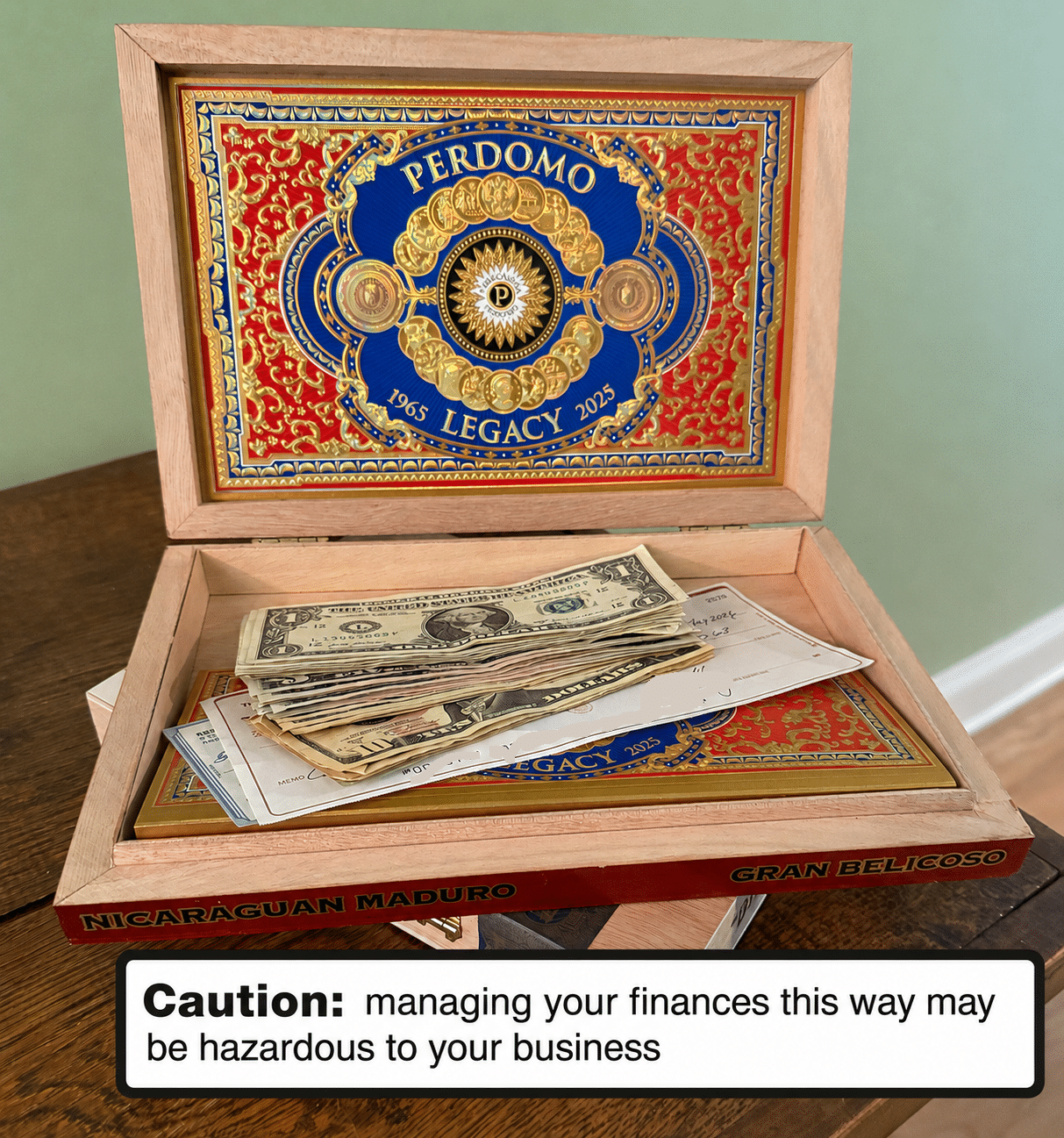
That cigar box is what “bookkeeping” looks like for a lot of small local businesses—receipts, scribbled notes, a few bank statements, maybe an invoice printout or two. Not because the owner doesn’t care, but because the work feels disconnected from real life.
Until it isn’t.
Because the real danger of bad bookkeeping is that it usually doesn’t blow up today. It leaks. Quietly. Month after month. And when the leak finally shows up, it shows up as:
- cash flow stress
- customers who “paid” (but you can’t prove it)
- tax bills that feel random
- cleanups that cost more than they should
- late penalties and interest that didn’t need to happen
Let’s put the cost into plain English.
What does “bad bookkeeping” actually look like in a small local business?
Bad bookkeeping usually isn’t fraud. It’s not even laziness.
It’s a business operating without a reliable scoreboard.
Here are the most common patterns we see in small local businesses:
- No monthly reconciliation. Nobody regularly compares the books to bank/credit card statements.
- Income is tracked loosely. Deposits hit the bank, and that becomes “the system.”
- Invoices go out late (or inconsistently). Or they go out, but nobody follows up.
- Customer payments aren’t applied correctly. Money comes in, but it’s not tied cleanly to the right invoice/customer/job.
- Expenses are a mess. Transactions sit uncategorized, or get dumped into a catch-all category.
- Personal and business spending are mixed. “I’ll sort it out later” becomes a yearly tradition.
- Everything gets handed to the CPA at tax time like a bag of parts and a prayer.
If any of those sound familiar, you’re not alone.
But you should treat it like the warning label it is.
How does bad bookkeeping cause cash flow problems—even when sales look fine?
A lot of owners think cash flow problems mean one thing:
“We need more customers.”
Sometimes, sure.
But plenty of businesses have cash flow problems because the back office is leaking money or delaying money.
Here’s how that happens:
1) Your bank balance becomes your “financial report”
If the only number you trust is what’s in the bank today, you’re driving by looking out the side window.
Because the bank balance doesn’t tell you:
- what’s already spoken for (payroll, taxes, rent, materials)
- what’s overdue (A/R you should already have collected)
- what you’ve actually earned vs. what you’ve collected
- whether last month was profitable, or just “busy”
2) You can’t spot leaks
Small leaks add up fast:
- duplicate subscriptions
- vendor price creep
- recurring charges that nobody remembers signing up for
- “misc” expenses that are actually major categories hiding in plain sight
- missed reimbursements
- chargebacks and refunds you forget to track
3) You can’t forecast even 30 days out
Cash flow becomes emotional. You feel fine until you don’t.
And the business starts running on last-minute decisions:
- “Can we make payroll?”
- “Should I delay paying this vendor?”
- “Do I have enough to buy this equipment?”
- “Can I hire?”
- “Can I pay myself?”
Those are not the questions you want to be guessing on.
Illustrative example: A contractor has a $140k month in deposits and feels great—until payroll, materials, and sales tax hit the same week, and they realize they were “busy” but not liquid. That’s not a sales problem. That’s a control problem.
How does bad bookkeeping make you lose track of customer payments (and why that’s expensive)?
This is one of the most common “hidden costs” because it hits twice:
- you don’t collect money you earned (or you collect it late)
- you spend time arguing, searching, re-sending, and re-checking
Here’s where things usually break:
Invoices go out late
If invoices don’t go out quickly, payments don’t come in quickly. Simple math.
Payments don’t match invoices cleanly
Common issues include:
- customer pays multiple invoices with one payment, and nobody applies it correctly
- customer pays a partial amount, and the balance sits unnoticed
- payment is recorded in the wrong place (or twice)
- deposits get recorded, but not linked to a job/customer, so nobody can tell what’s still owed
Past-due follow-up becomes random
If nobody owns A/R, it becomes “whoever remembers.”
And late payments are not a niche problem. In the U.S., Intuit reports 56% of small businesses are owed money from unpaid invoices, and 47% say some invoices are overdue by more than 30 days, based on a January 2025 survey of 2,487 U.S. small businesses (Intuit QuickBooks, 2025).
You don’t need a fancy finance department to address this.
You need a consistent process.
How does bad bookkeeping lead to paying too much tax (even if your CPA is good)?
This one surprises people.
Owners assume:
“My CPA will make sure I don’t overpay.”
Your CPA can help a lot—but they can’t invent clean records that don’t exist.
Bad bookkeeping leads to overpaying taxes mainly in two ways:
1) Missed deductions
If transactions aren’t categorized correctly or don’t have proper support, deductions get missed.
That means:
- your reported profit is higher than reality
- your tax bill is higher than it should be
2) Decisions get made off the wrong profit picture
When your books are unreliable, you make decisions like:
- how much to set aside for taxes
- whether you can afford to hire
- whether a new truck/equipment purchase makes sense
- whether you’re actually profitable on certain job types
And when those decisions are wrong, the “fix” is usually expensive and last-minute.
What IRS penalties and interest can show up when the books are wrong or late?
Not legal or tax advice—just a hard truth: the IRS doesn’t accept “my bookkeeping was messy” as a reason.
If your tax filings or payments are late, penalties can stack.
A few key examples (straight from the IRS):
- Failure-to-file penalty: generally 5% of the unpaid tax per month (or part of a month), up to 25% (IRS)
- Failure-to-pay penalty: generally 0.5% of the unpaid tax per month (or part of a month), up to 25% (IRS)
- Accuracy-related penalty: generally 20% of the underpayment for certain types of errors (IRS)
Even if your CPA is solid, late or inaccurate inputs can force late or inaccurate outputs.
This is why “we’ll fix it at tax time” tends to cost more than people expect.
What records should you be keeping so you’re not guessing later?
If your recordkeeping system is “I’ll find it when I need it,” you’re setting yourself up for stress.
The IRS is clear that businesses should keep records that support the income, deductions, and credits on their return, and it includes things like receipts, invoices, and other proof of income/expenses (IRS recordkeeping).
And yes—digital records count if they’re accurate and readable.
For how long to keep records, the IRS provides guidance that varies by situation (IRS).
Plain-English takeaway: if you don’t have clean records, you don’t have options. You have guesses.
What does “good enough” bookkeeping look like for a small local business?
Most owners don’t need perfection.
They need a monthly rhythm they can trust.
Here’s a “good enough” standard that prevents the majority of financial chaos:
Monthly bookkeeping checklist (the basics that keep you in control)
- Reconcile bank and credit card accounts (every month, no exceptions)
- Categorize uncategorized transactions (so your P&L means something)
- Review Accounts Receivable (A/R): who owes you money, and how long it’s been overdue
- Review Accounts Payable (A/P): what you owe and what’s coming due
- Review your Profit & Loss and ask one question: does this match reality?
- Make sure receipts/invoices are saved in a way you can retrieve later
If you want the short version: start by reconciling your accounts monthly. That one discipline eliminates a shocking amount of chaos.
When should you stop DIY bookkeeping and get help?
DIY bookkeeping stops working when the business outgrows the owner’s spare time.
A few signs it’s time:
- You don’t trust your financial reports.
- You’re surprised by your tax bill every year.
- You’re behind on invoicing and collections.
- Your CPA asks questions you can’t answer cleanly.
- You don’t know your margins by job/service type.
- You feel like you’re working hard but can’t tell if you’re winning.
If that’s you, the fix is rarely “try harder.”
It’s usually:
- clean up what’s broken
- set a simple monthly standard
- connect the accounting to how the business really runs
Also, if you’ve ever been tempted by the lowest price option because “bookkeeping is bookkeeping,” read this: cheap bookkeeping can be surprisingly expensive. That post tells the story behind why the “savings” often show up later as losses.
Conclusion: treat bookkeeping like a control system, not paperwork
If you own a small local business and you’ve been treating bookkeeping like a chore you’ll deal with later, here’s the hard truth:
Bad bookkeeping is hazardous to your business finances.
Not because you’ll get “in trouble” tomorrow.
But because it quietly damages the three things you can’t afford to guess on:
- cash flow
- collections
- tax reality
The goal isn’t perfect books.
The goal is books you can trust—every month—so you can make decisions with confidence instead of hope.
If you want to talk through what’s going on in your back office and what needs to be cleaned up (without pressure), schedule a call with Gary and we’ll help you get a clear next step.